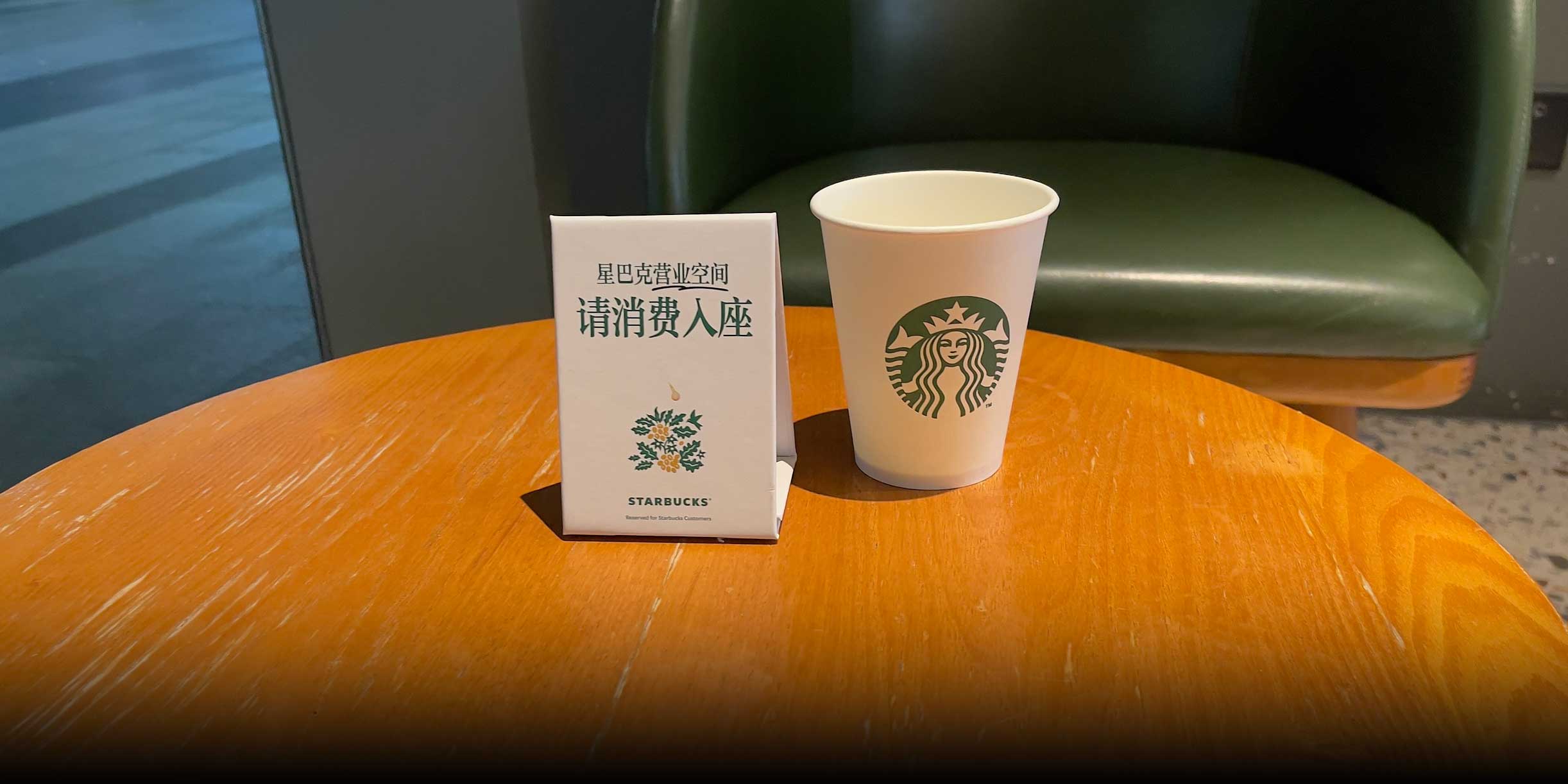
Starbucks’ Pay-to-Sit Policy Tests ‘Third Place’ Image in China
For nearly 27 years, Starbucks coffeehouses in China have been a haven for non-paying patrons attracted by its comfortable seating, ample power outlets, air conditioning, and free restrooms.
This stemmed from the American company’s foundational brand concept of making its outlets “third places” — safe, accessible spaces between home and work to relax and connect with friends, whether you intend to spend or not.
Now, it seems, spending is mandatory.
In late October, Starbucks China introduced a nationwide purchase-required seating policy, pledging to be “clear in its rules but warm in its execution,” with staff encouraged to politely stop non-paying customers from hogging tables and chairs. At the same time, it unveiled plans to invest more than 300 million yuan ($45 million) in reshaping the in-store atmosphere.
As the company undergoes major corporate restructuring while continuing to expand, does it risk losing its “third place” image in China?
Stirred up
The first Starbucks on the Chinese mainland opened in Beijing’s World Trade Building in 1999. Today there are about 8,000 outlets across 1,100 counties in the mainland.
Li Kele regularly visits her local store in the southwestern Sichuan province. After walking in and sitting down on Oct. 21, taking a moment to browse various online platforms for discounts, Li was soon approached by a barista brandishing a menu and asking if she needed any help. “The store never used to push customers to place an order,” she says.
Starbucks outlets have been attracting non-paying patrons since the 1980s, and the company officially adopted a worldwide open-door policy in 2018.
However, concerns over disruptive behaviors, alongside the company’s desire to prioritize paying customers and staff’s experience, prompted the global headquarters to reverse the policy in January last year.
The change began at its North American stores, where a new code of conduct stated that Starbucks coffee shops, patios, restrooms, and other facilities were for employees and customers only.
Anecdotal evidence suggests baristas in China began nudging seated patrons to make purchases in early 2026.
One customer shares that in January they observed employees at a Starbucks branch in Beijing’s central Xidan shopping district walking around the store offering table service to people without drinks, which is not typically available, and promoting discount coupons. Sometimes they’d subtly point out that the store was crowded and seating was scarce.
On Oct. 19, social media users in several cities began posting about signs spotted at Starbucks stores that stated customers should “make a purchase before taking a seat.”
When a domestic media outlet contacted Starbucks China for a response that same day, a spokesperson denied any plan to introduce a purchase-required seating policy. But within 48 hours, the company made a complete U-turn, announcing that such a policy would take effect on Oct. 22.
The move has sparked much debate online. Yet in real terms, implementation has so far been limited to advisory measures, such as signage.
“The latest wording is that they (head office) encourage us to ask people to leave,” says Zhang Yi, a part-time Starbucks barista. “They want us front-line staff to persuade non-paying customers to give up their seats in whatever way we consider peaceful.”
However, because the practice isn’t tied to their performance review, employees might be reluctant to enforce the new rules, Zhang adds. “If I’m on shift, I won’t do it. I’ll just work the way I always have.”
In the grind
Starbucks built its “third place” branding concept based on the American sociologist Ray Oldenburg’s 1989 book, “The Great Good Place,” in which he describes the human need for communal, welcoming social environments separate from home (the “first place”) and work (the “second place”).
This positioning requires providing space for relaxed socializing. But when revenues don’t keep pace with increases in rent and operating costs, it becomes a potential pain point.
When Brian Niccol was appointed CEO of Starbucks in September 2024, same-store sales — a metric that measures revenue growth from established locations — were on the slide in the U.S. market.
To reverse the trend, he launched “Back to Starbucks,” a plan aimed at “rediscovering the power of third places” by improving the in-store experience, such as reintroducing old-school ceramic mugs and handwritten names on cups, as well as more comfortable seating. He then scrapped the 2018 open-door policy.
Investor data suggests the changes have already had an effect in North America, where same-store sales were up by 8.1% year on year in the third quarter of fiscal 2026 (Sept. 29, 2025, to Sept. 27, 2026) and same-store transactions grew by 4.5% over the same period.
In China, recent growth in same-store sales has been powered more by product innovation, deliveries, and price adjustments, according to Cathy R. Smith, Starbucks’ chief financial officer.
As online take-out orders increase and in-store spending declines, running a brick-and-mortar “third place” becomes more expensive. In this case, seat-hogging shifts from being a tolerable service issue to an operational problem.
Pressing issue
In April this year, Starbucks completed a $4 billion joint-venture transaction with Boyu Capital, a China-focused alternative asset management and private equity firm based in Hong Kong. The deal gives Boyu a 60% share in Starbucks’ China retail business and transitions all 8,000 coffeehouses into licensed operations.
The U.S. coffee giant says it expects the transaction proceeds, along with the value of its retained 40% stake and licensing agreement, to account for more than $13 billion over the next decade. In the third quarter of fiscal 2026, Starbucks’ international segment operating margin increased to 19.1%, up from 13.6% a year earlier.
However, while the deal benefits global headquarters, Starbucks China still faces pressure to expand. At a partner forum in April, CEO Molly Liu confirmed the company is already two-thirds of the way to its goal of opening stores in more than 1,500 counties over the next three years.
With this in mind, the purchase-required seating policy looks more like an efficiency drive, as the company attempts to cut costs.
This also comes amid a major restructuring of Starbucks China’s workforce. As all staff are now part of the joint venture, they can no longer hold Starbucks shares, which trade on New York’s Nasdaq exchange. This means the end of the Bean Stock program in China, which since 1991 has awarded full- and part-time employees shares after a certain tenure.
Liu said at April’s partner forum that benefits would continue through fiscal 2026, with a new long-term incentive plan to be introduced in the fourth quarter. As of Nov. 4, there had been no further announcements.
As social insurance contributions are mandatory only for permanent staff in China, barista Zhang believes the company prefers to hire part-time workers. Jiemian News reported in January that Starbucks China’s official recruitment channels were promoting vacancies in 269 areas, with full-time positions making up just over 20%.
Behind its new seating policy is a contradiction Starbucks China cannot easily escape: the “third place” concept justifies the brand’s premium, yet recent growth has come from deliveries and discounts, bringing sales without a customer ever sitting down.
The joint venture and its target to grow to “as many as 20,000 locations over time” sharpen that contradiction. Smaller markets and leaner per-store costs make it hard to build to the original standard.
Therefore, tightening seating rules, restructuring its workforce, and expansion look less like separate decisions than part of one cost logic.
(Due to privacy concerns, Li Kele and Zhang Yi are pseudonyms.)
Reported by Zhan Fangge.
A version of this article originally appeared in Baobian News. It has been translated and edited for brevity and clarity, and is republished here with permission.
Translator: Kiong Xin Xi; editors: Wang Juyi and Hao Qibao.
(Header image: A sign asks customers to make a purchase before taking a seat at a Starbucks. VCG)